
Shape memory alloy
How shape memory alloy artificial muscles work
Why SMA moves like muscle
Shape memory alloy (SMA) is a metal that returns to its original shape when heated, even after being deformed. That property can be used to build an artificial muscle controlled by electricity. This article explains why SMA contracts, and what the path from wire to coil to woven fabric solved.
At a glance
Shape memory alloy
A metal (NiTi) that returns to its original shape when heated
Coil to fabric
Coiling grows the stroke; weaving spreads force across a surface
Limits and fixes
Heat, cooling speed, lifetime — thinner wire improves response
Applications
Wearable robots, soft robotics, medical devices, haptics
What shape memory alloy is
Shape memory alloy is a metal that returns to its original shape when heated above a certain temperature, even after being deformed by force. Nitinol (NiTi), an alloy of nickel and titanium, is the most widely used.
It is already familiar from medical stents and eyeglass frames. Using it as an artificial muscle applies that same restoring force as a source of motion.
Why it behaves like muscle
The restoring behaviour comes from a phase transformation — the crystal structure changes with temperature. At lower temperatures it takes a structure that deforms easily; at higher temperatures, one that remembers its original shape.
Current is the means of raising the temperature. Passing current through the metal generates heat through resistance, and that heat drives the transformation, contracting the material. Cut the current and heat escapes to the surroundings, returning it to its original length.
The repeated contraction and relaxation resembles how muscle behaves. That is not to say it produces force the same way muscle does, but being able to control contraction with an electrical signal is why it is used as an artificial muscle.
From wire to coil
Used as straight wire, shape memory alloy has a limited contraction ratio — only a few percent of its length, so moving a joint through a large range would need a very long wire.
Winding the wire into a coil spring changes that. The deformation of the metal itself is unchanged, but the coil compresses and extends to produce a much greater change in length — a much larger stroke from the same material.
The trade-off is that a coil needs more material to produce the same force. Stroke and force are exchanged against each other.
Coiling yields a far larger stroke from the same material.
From coil to fabric
There is a limit to the force a single coil yarn can produce. Bundling strands increases force, but the bundle grows thick and becomes hard to build into clothing.
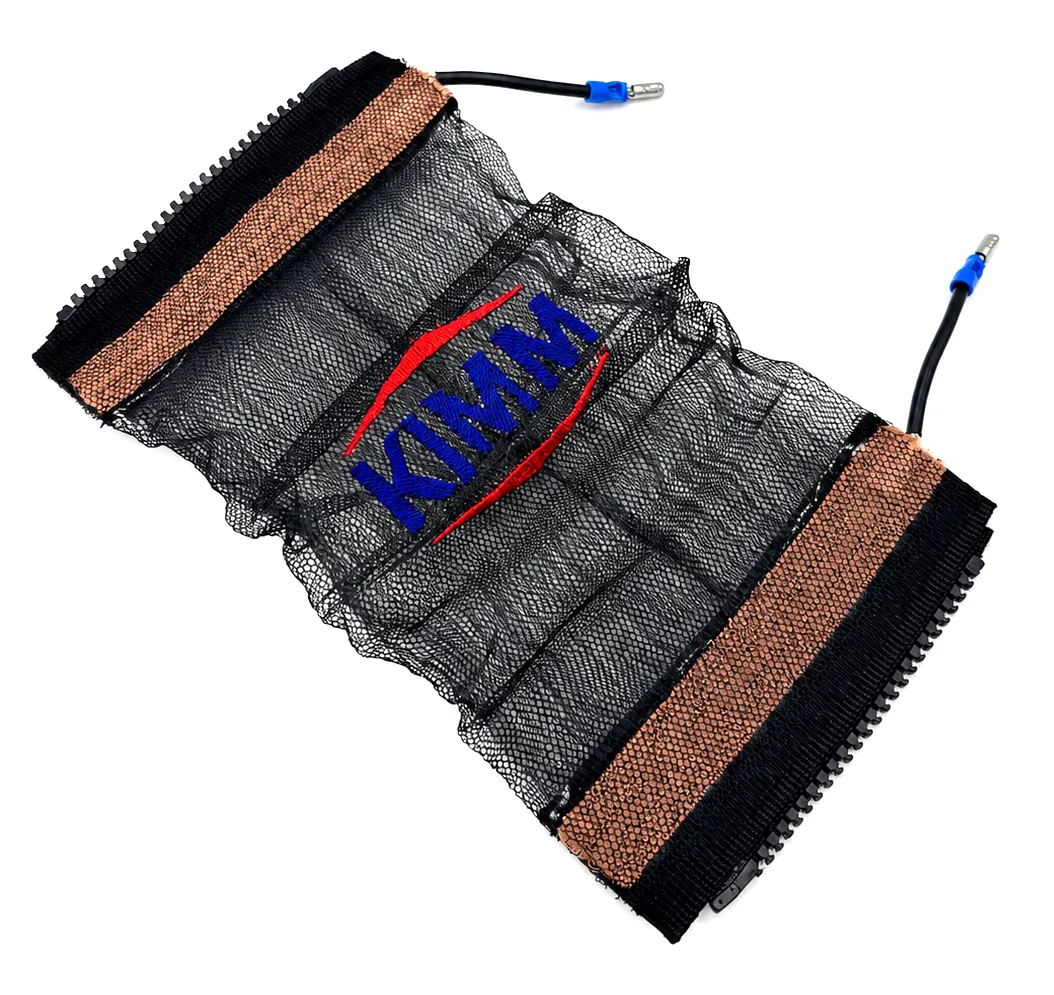
Weaving many coil yarns like cloth produces a thin, broad surface actuator. Force spreads across the surface rather than concentrating at one point, and the low profile fits inside a garment.
The woven structure matters for another reason: it can be cut and sewn along designed patterns. The actuator can be handled like yardage rather than like a component.
The actuator can be handled like yardage, not like a component.
Stroke by form
- Straight wireA few percent of its length
- Coil springThe coil compresses and extends, growing the stroke
- Woven fabricSpreads force across a surface and fits inside a garment
A conceptual diagram of how the achievable change in length differs by form. Bar lengths indicate relative tendency, not measured values.
Shape Memory Alloy Wire
SMA Wire
Uses thin shape memory alloy wire, 25–40 μm in diameter.
Coiling & Weaving
Coil & Weave
The wire is processed into coil-spring thread, then woven like fabric into a textile actuator spanning a wide surface.
Contract & Relax
Works Like a Muscle
Applying current makes it contract; it then cools and recovers before the next motion.
Limits and how they are addressed
Three challenges are characteristic of shape memory alloy actuators: heat during operation, response speed limited by cooling time, and lifetime under repeated use.
Response speed improves as the wire gets thinner, because a higher surface-area-to-volume ratio lets heat rise and fall faster. Fabric Muscle uses wire on the order of 25–40 μm in diameter to improve this.
Designing cooling structures alongside has also been studied. Heat is not something that can be removed entirely, so products are designed with the garment layer insulating between skin and actuator.
Compared with other artificial muscles
Pneumatic artificial muscles (PAM) inflate with air pressure and contract. They are strong and fast, but the pump, valves and air lines make the overall system large.
Dielectric elastomers (DEA) are polymers that thin and stretch under applied voltage. They respond quickly and weigh little, but need voltages in the kilovolt range. Ionic polymers (IPMC) run on low voltage but produce small forces.
Shape memory alloy is structurally simple and produces large forces at low voltage, but because heat is the medium, cooling time governs response speed. These approaches suit different conditions rather than ranking against each other.
Applications
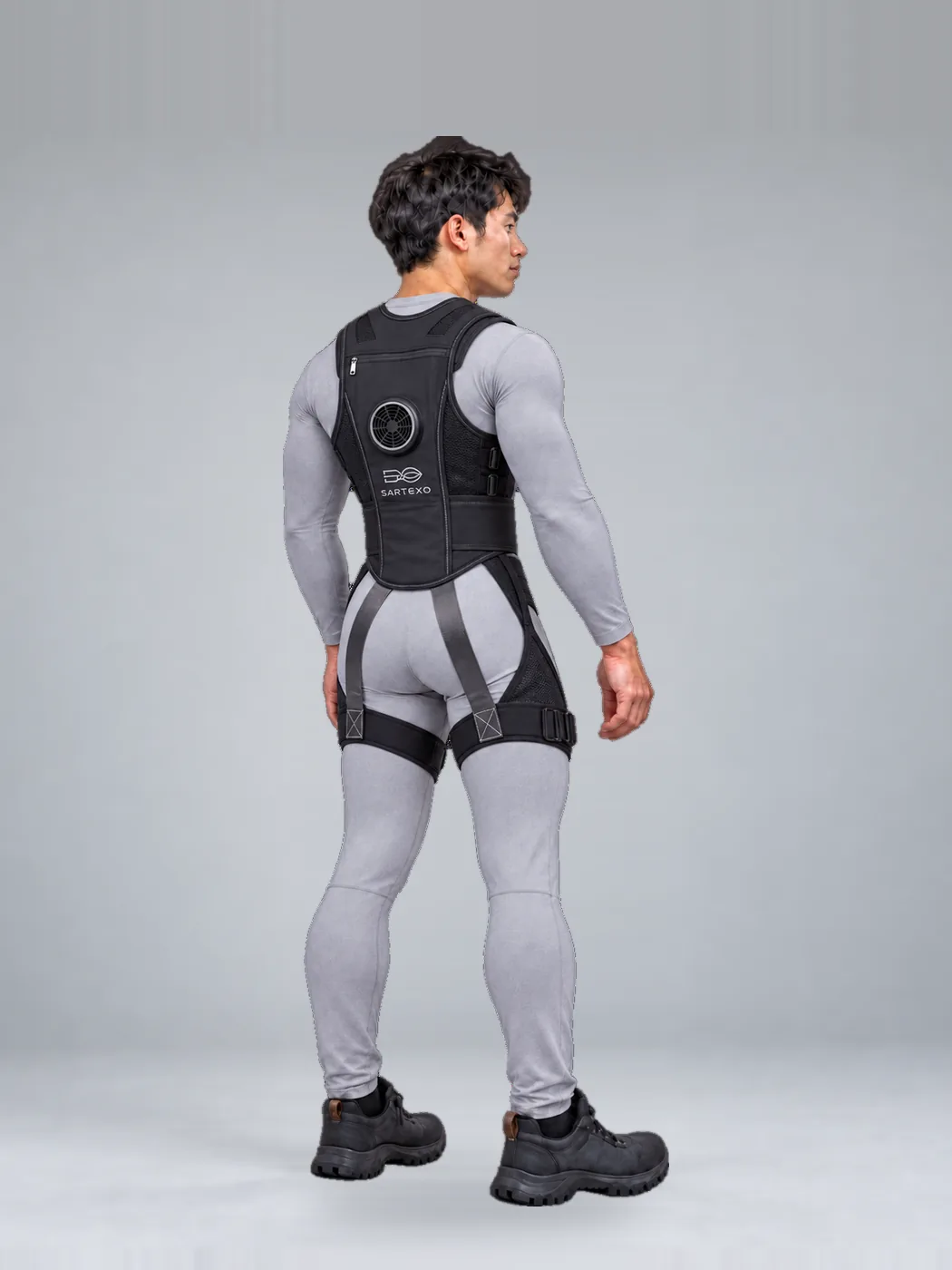
Wearable robots are the most active application: they need light, soft actuation, and noise and bulk are problems in anything worn against the body.
Research also continues in soft robotics, medical devices and haptic devices that convey touch. What they share is an environment where rigid mechanisms are hard to use.
References
Suit-type Wearable Robot Powered by Shape-memory-alloy-based Fabric Muscle
Scientific Reports (2019)
A Novel Fabric Muscle Based on Shape Memory Alloy Springs
Soft Robotics (2019)
Fabric muscle with a cooling acceleration structure for upper limb assistance soft exosuits
Scientific Reports (2022)
Frequently asked questions
Cycle life depends heavily on operating conditions — how large a deformation is applied and over what temperature range. A single number is therefore hard to state; a product-level cycle figure is only meaningful alongside its conditions.
Straight wire has a limited contraction ratio relative to its length. Winding it into a coil keeps the metal's own deformation the same while the coil compresses and extends, yielding a much larger change in length.
Primarily by natural convection to the surrounding air. Thinner wire lets heat escape faster and improves response, and structures that assist cooling have also been studied.
Learn more
Related reading
 Concept image
Wearable robots
What is a wearable robot?
A robot worn on the body to assist strength and movement. Where the actuator sits has reshaped the whole form factor.

Fabric Muscle
What is Fabric Muscle?
A textile artificial muscle actuator woven from shape memory alloy coil yarn. It contracts on current alone, with no motor.
Get Started
Ready to Work With Us?
Product adoption, pilot requests, technology partnership — start the conversation with SARTEXO.