
Fabric Muscle
What is Fabric Muscle?
A textile that contracts to generate force
Fabric Muscle is an artificial muscle actuator made by processing shape memory alloy into fine coil yarn and weaving it like cloth. When current flows, the whole fabric surface contracts like muscle and produces force. It began as an attempt to turn a wearable robot's actuator into textile.

At a glance
What it is
A textile artificial muscle woven from SMA coil yarn
How it works
The fabric itself contracts when current flows
How strong
10 g lifted 10 kg in actuator-level testing
Where it is used
Clothing-type wearable robots, soft robotics, research actuators
In one line
Fabric Muscle is a textile artificial muscle actuator woven from shape memory alloy (SMA) coil yarn. It looks much like a dark woven fabric, but it contracts and produces force when current is applied.
The word "actuator" is the key. It is not a brace that supports the body or a band that returns stored elasticity — it takes electrical energy and generates force itself.
How it is made
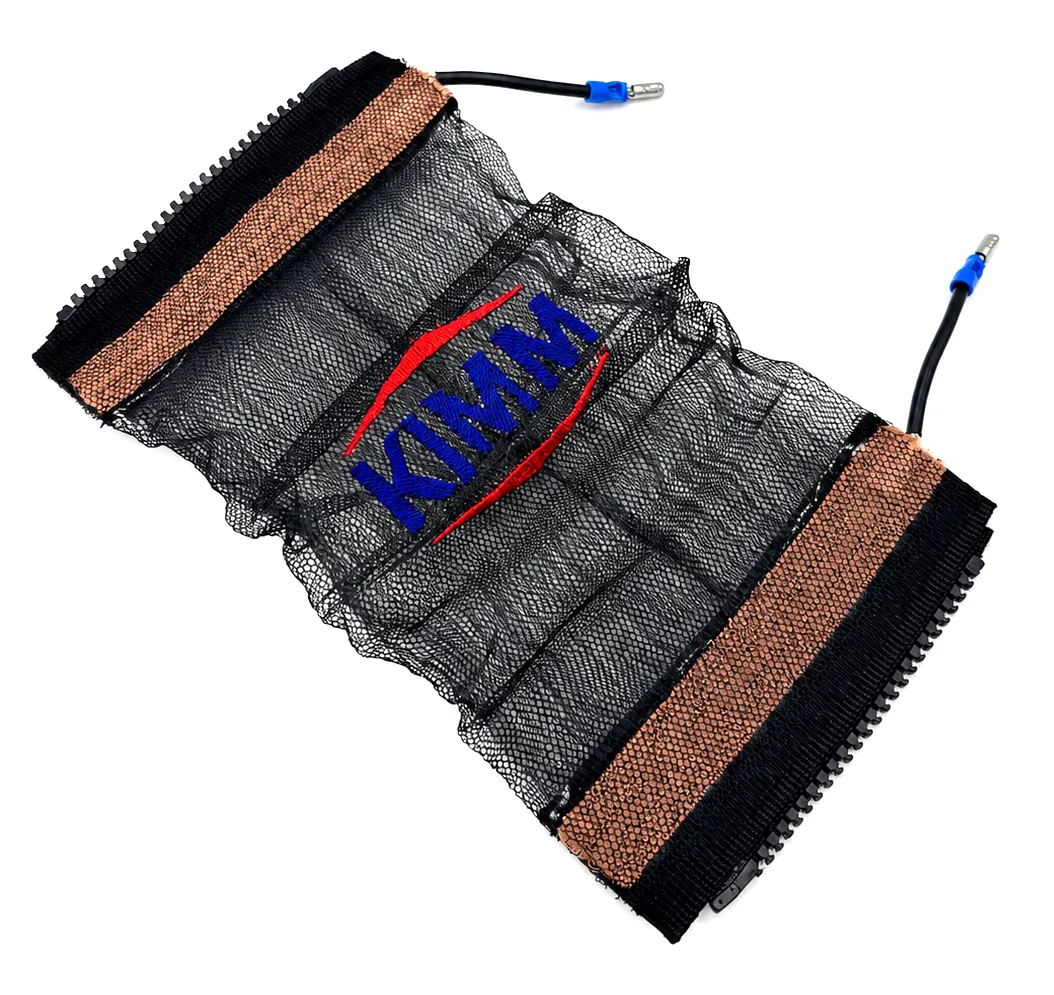
It starts with shape memory alloy wire finer than a human hair. Processing that wire into a coil-shaped yarn produces an element that can deform far more than the straight wire could.
Weaving that coil yarn like cloth produces an actuator with a broad surface. Because force comes from a surface rather than a single strand, it can handle more than any one strand could.
The detailed process conditions are not published. At a conceptual level, three steps are enough: fine metal wire, then coil yarn, then a woven surface.
How it works
Shape memory alloy returns toward its original shape as its temperature rises. Fabric Muscle uses that property. When current flows, resistance raises the temperature, the coils contract, and the fabric pulls.
Cut the current and the temperature falls, returning it to its original length. Adjusting the size and timing of the current controls how much force is produced and when it starts.
There is no motor, no gearbox and no hydraulics. With no rotating parts, no drive noise is produced — a consequence of the structure.
No motor, no gearbox, no hydraulics.
How strong is it
In actuator-level testing, 10 g of Fabric Muscle was demonstrated lifting 10 kg — roughly 1,000 times its own weight — and supported up to 1,500 times its own weight at the test maximum.
It is worth noting that these are actuator-level figures. The conditions differ from the performance of a finished suit, where the garment structure and how it is worn both come into play, and which is therefore evaluated on its own terms.
Figures measured under different test conditions should not be read as if they came from one.
10 g of fabric lifted 10 kg.
What makes it different
 Concept image
The biggest difference is that it is fabric. It can be cut and sewn along designed patterns. That means garment manufacturing can be used, and products can be built without a separate robot assembly line.
It also means no frame or hinge is needed to mount the actuator. With no such structure, joint movement is not mechanically constrained.
No motor or gearbox also means no drive noise. That said, the actuator does heat during operation, so products are designed with the garment layer insulating between skin and actuator.
Where it is used
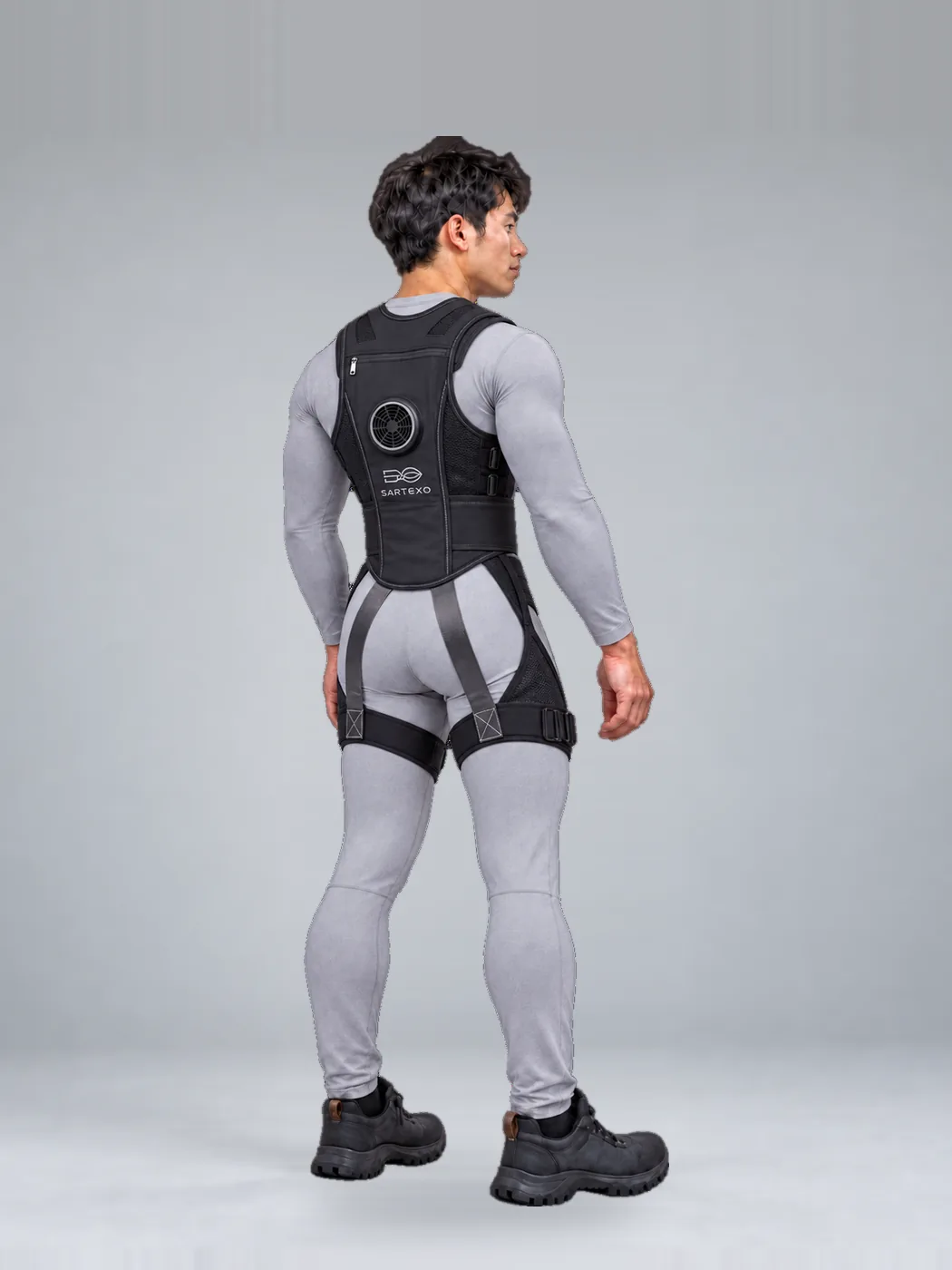
The most direct use is clothing-type wearable robots, where it serves as the actuator in suits that assist joints such as the waist, shoulder and elbow.
It can also be used in soft robotic hands and grippers, and in rehabilitation devices — anywhere soft actuation is needed. It is supplied as standalone actuators and evaluation kits for research institutions and corporate R&D.
Compared with other artificial muscles
There are several approaches to artificial muscle. Pneumatic artificial muscles inflate with air pressure and can produce large forces quickly, but require a pump, valves and air supply lines alongside.
Dielectric elastomers deform under applied voltage and respond quickly, but need high voltages. Straight shape memory alloy wire is structurally simple, but its contraction ratio is limited in that form.
Fabric Muscle coils the alloy to get past that contraction limit, then weaves it so force is produced across a surface. Rather than one approach being superior, a different structure brings different characteristics.
Comparing artificial muscles
| Pneumatic (PAM) | Dielectric Elastomer (DEA) | SMA Wire | Fabric Muscle | |
|---|---|---|---|---|
| Actuation principle | Air pressure | Electrostatic force | Shape-memory phase transformation | Shape-memory phase transformation |
| Peripheral equipment | Pump, valves, air lines | High-voltage supply & driver | Power supply & driver | Power supply & driver |
| Operating condition | Compressed air | kV-range high voltage | Low voltage, current-driven | Low voltage, current-driven |
| Form | Tube | Film | Linear (1D) | Textile sheet (2D) |
| Garment integration | Limited | Limited | Limited | Integrable as textile |
The actuation method determines the required system configuration and how it integrates into garments.
Frequently asked questions
It looks like a woven textile, but it is woven from shape memory alloy coil yarn, so it contracts and produces force when current flows. Ordinary fabric only covers the body; Fabric Muscle is an actuator that generates force.
The actuator does heat during operation. Products are therefore designed with the garment layer insulating between skin and actuator, and safe temperature management is required when handling the standalone actuator.
There is no drive noise, because no motor or gearbox is used. It follows from a structure with no rotating or meshing parts.
Yes. It is supplied to research institutions and corporate R&D as standalone actuators, research evaluation kits, and custom builds. Specifications and supply terms are provided on inquiry.
Learn more
Related reading
 Concept image
Wearable robots
What is a wearable robot?
A robot worn on the body to assist strength and movement. Where the actuator sits has reshaped the whole form factor.
Shape memory alloy
How shape memory alloy artificial muscles work
Shape memory alloy returns to its original shape when heated. Coiling and weaving turn that into a surface-level artificial muscle.
Get Started
Ready to Work With Us?
Product adoption, pilot requests, technology partnership — start the conversation with SARTEXO.